
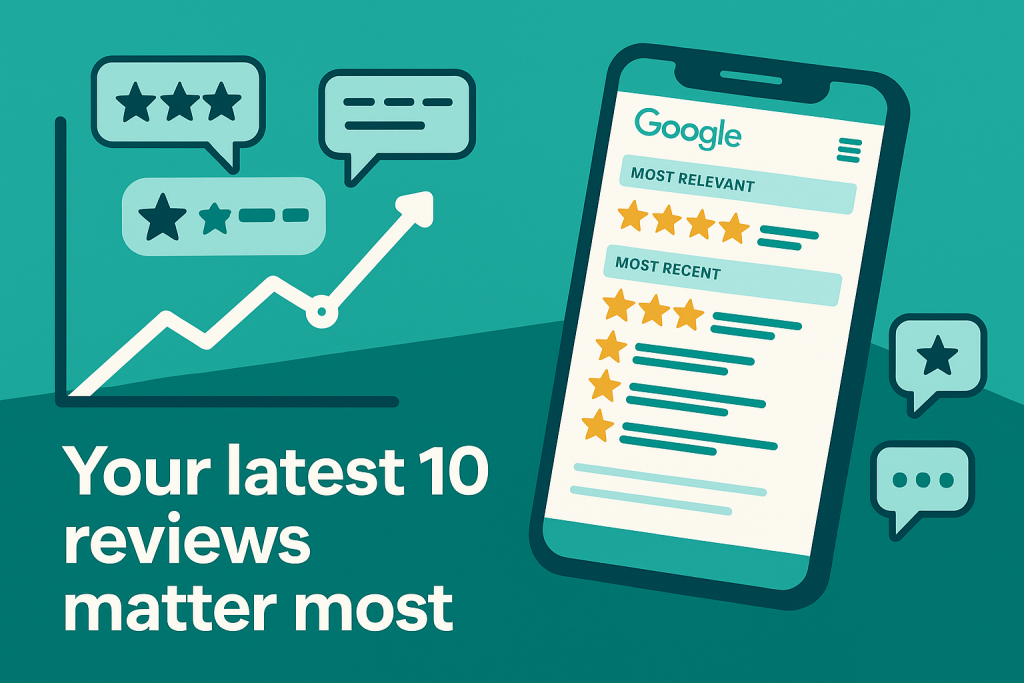
Most business owners obsess over the total number of reviews:
“We finally hit 100 reviews!”
“Our competitor has 300 reviews… how do we catch up?”
Don’t get me wrong—volume matters. But when it comes to how customers decide and how Google ranks you, your most recent 10 reviews often matter more than your first 100.
If you’ve been stuck at a mediocre star rating, or you’re worried about a few bad reviews dragging you down, this is very good news: you don’t have to rewrite your entire history. You just have to win the “last 10.”
Let’s break down why.
1. Customers Sort by “Most Recent,” Not “All-Time”
Put yourself in your customer’s shoes for a second.
You search for:
- “dentist near me”
- “HVAC repair in Boulder”
- “med spa in Austin”
You tap a business, skim the rating, and then what do you do?
You scroll straight to the latest reviews.
You’re not reading what people said three years ago. You’re looking at:
- What happened last week
- The last 5–10 reviews
- Whether things are trending up or down
If your first 100 reviews are great but your last 10 are:
- Complaints about rude staff
- “They’ve gone downhill”
- “New ownership is terrible”
…you’ve got a real problem—whether your overall rating says 4.6 or not.
On the flip side, if your early reviews were rocky but your last 10 are full of:
- “Best experience I’ve had here”
- “Been coming for years, but they’ve really leveled up”
- “New team is awesome”
…then a skeptical buyer can see a clear story: this business improved.
Takeaway: People use your most recent reviews as a “health check,” not your all-time average.
2. Recency Signals to Google That You’re Alive and Trusted
Google doesn’t just want “popular” businesses; it wants reliable, currently trusted ones.
Fresh reviews send signals like:
- This business is active
- Customers are still coming in
- People still trust them enough to leave feedback
If you have 200 reviews but haven’t added one in six months, that’s a yellow flag. To Google, that might look like:
- Declining quality
- Less foot traffic
- A business that may not be as relevant anymore
Meanwhile, a competitor with only 60 total reviews but 10 new reviews in the last month looks:
- Active
- Engaged
- Worth surfacing higher in local search and Maps
That’s why a steady stream of recent 4–5 star reviews can have more impact on your visibility than a big pile of old reviews.
Takeaway: Recency helps with local ranking and visibility. Your last 10 reviews are a vital freshness signal.
3. Your Last 10 Reviews Control the “Vibe”
Humans are wired to overweight recent information. This is called the recency bias—and it’s brutal in online reviews.
Even if:
- Your first 100 reviews are solid, and
- Your average rating is technically fine…
…a streak of 3–4 negative or lukewarm reviews in your last 10 will:
- Sour the overall vibe
- Create doubt: “Has something changed?”
- Make a prospect go back and click on a competitor
Conversely, if:
- Your early reviews are mixed
- You’ve made improvements (new staff, new processes, new ownership)
…your last 10 reviews are your chance to rewrite the narrative.
A batch of recent positive reviews does a few things psychologically:
- It reassures people: “Okay, whatever issues they had, they fixed them.”
- It makes negative reviews look outdated and less relevant.
- It gives prospects language to latch onto: “Everyone keeps mentioning how friendly the new hygienist is,” etc.
Takeaway: Your most recent reviews tell the story of “who you are now,” which is what people actually care about.
4. A Bad Streak in Your Last 10 Hurts More Than You Think
Let’s say your numbers look like this:
- Total reviews: 120
- Overall rating: 4.3★
- Last 10 reviews: 6 negative, 4 positive
At a glance, a 4.3 rating isn’t terrible. But most shoppers will:
- Click “Most recent”
- See a cluster of complaints: long waits, rude staff, rushed visits, poor communication
- Think: “They’re going downhill. I’ll try someone else.”
Even worse, prospective customers rarely do the math. They don’t say:
“Well yes, the last 10 were rough, but across 120 visits the weighted average suggests…”
They just see a streak of bad experiences and move on.
And for some verticals (healthcare, legal, home services), one or two detailed negative reviews can be enough to scare people away, no matter how many old 5-stars you’ve got buried behind them.
Takeaway: A rough run in your last 10 reviews is like having your worst day pinned to the top of your profile.
5. Fixing the Last 10 Takes Less Effort Than You Think
Here’s the good news: getting your next 10 reviews right is far easier than rewriting your entire history.
Instead of thinking:
“We need 200 more 5-star reviews to catch up.”
Shift to:
“We need the next 10–20 reviews to be great, and we need them consistently.”
A basic plan:
- Ask every happy customer Right after a good experience, ask:
- “Would you mind leaving us a quick Google review? It helps more than you know.”
- Automate the ask Use email and/or SMS after visits to send a simple, branded review request. The easier you make it, the more reviews you’ll get.
- Follow up gently A nudge 2–3 days later can dramatically increase review volume without annoying people—especially if they’ve already had a positive experience.
- Route unhappy feedback privately Before they vent on Google, give them a direct channel:
- “Not happy? Click here to tell us what went wrong.” This lets you fix problems before they become public 1–2 star reviews.
Make that your default rhythm and your “last 10” will almost always look strong, no matter where you started.
6. How Repudoc Helps You Win the “Last 10” Game
If you’re reading this thinking, “We don’t have the time or system to manage this,” that’s exactly the problem Repudoc solves.
Repudoc is built to:
- Automatically request reviews from your real customers via email + SMS
- Filter unhappy feedback into a private channel so you can handle it internally
- Steadily generate fresh 4–5 star reviews so your latest 10 always tell the right story
- Show you progress: how your rating and review count are trending over time
Instead of manually begging for reviews and worrying about every bad one, you set it up once and let the system work in the background.
7. What to Do Next
If your Google profile:
- Hasn’t had a new review in weeks or months
- Shows a few ugly recent reviews at the top
- Looks worse than you know your current service actually is
…you don’t need a miracle. You need a better next 10 reviews.
Here’s a simple action plan you can start today:
- Open your Google Business Profile.
- Look only at your last 10 reviews.
- Ask yourself honestly:
- “If I were a new customer, what would I think?”
- If you don’t like the answer, commit to:
- Asking for reviews from every happy customer this week
- Responding thoughtfully to your last 10 reviews (especially the bad ones)
- Putting a simple system in place so this happens every week, not just when you remember
And if you’d like help doing that without adding another task to your staff’s plate, that’s exactly what we built Repudoc for.

Ready to Make Your Next 10 Reviews Count?
Your next 10 reviews have more power than your first 100. They define your current reputation and heavily influence whether someone chooses you—or your competitor.
If you want to:
- Clean up a rough streak
- Build a steady stream of fresh 5-star reviews
- Turn your Google profile into a real growth engine