
`
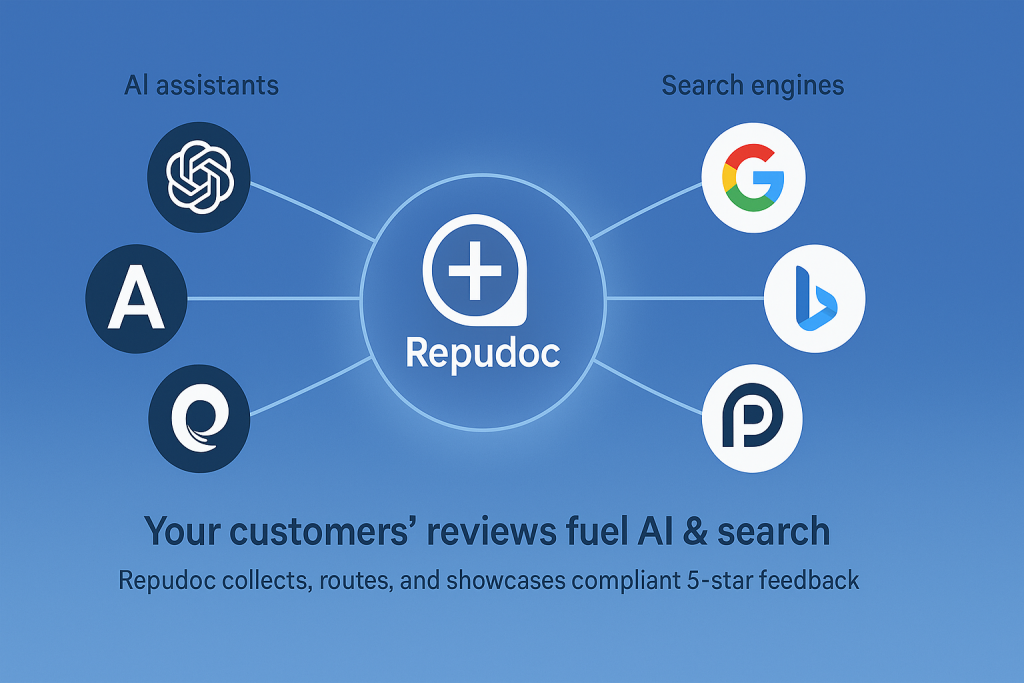
If you’re running a business today, your Google reviews are your reputation. They’re also fast becoming your AI reputation. When people ask ChatGPT, Claude, Gemini, or Perplexity “Who are the best dentists near me?” or “Which clinic treats X?”, these systems look for strong, consistent signals of authority. Public customer reviews are one of the clearest, scalable signals available: they show quality (stars), volume, recency, and consensus—all things search engines and AI models can understand at a glance.
This article explains why reviews help you rise in Google and Bing and make you more likely to be included in AI answers, and how Repudoc runs a compliant, repeatable process to generate those signals—no gating, no incentives, no fakes.

Why AI (and search) care so much about review
Modern search and AI assistants try to return answers that are useful and trustworthy. To do that, they weigh a mix of signals:
- Authority & consensus: Lots of real people saying the same thing (“this place is excellent”) is a powerful confidence booster for AI systems that summarize the web.
- Recency: Fresh reviews indicate the business is active and still delivering quality.
- Breadth: Reviews that exist across Google, Bing/Maps, Yelp, Healthgrades, WebMD, Facebook, and industry directories create a broad “entity footprint” that’s easier for AI to recognize and cite.
- Structure: Star ratings and review counts are structured data (numbers), which both search and AI can digest, compare, and rank quickly.
- Disambiguation: Reviews tied to consistent name–address–phone (NAP) data help AI systems match your entity to your website and profiles, reducing mix-ups with similarly named competitors.
Bottom line: When your business has a steady stream of genuine 5-star reviews in the open, you increase your odds of appearing in Google’s local pack, organic results, and in AI-generated answers that now accompany many searches.

The compliant way to get there: Repudoc’s workflow
Repudoc helps you collect more public, policy-safe reviews while protecting your brand and licenses. Here’s how it works:
- Invite every customer—automatically.
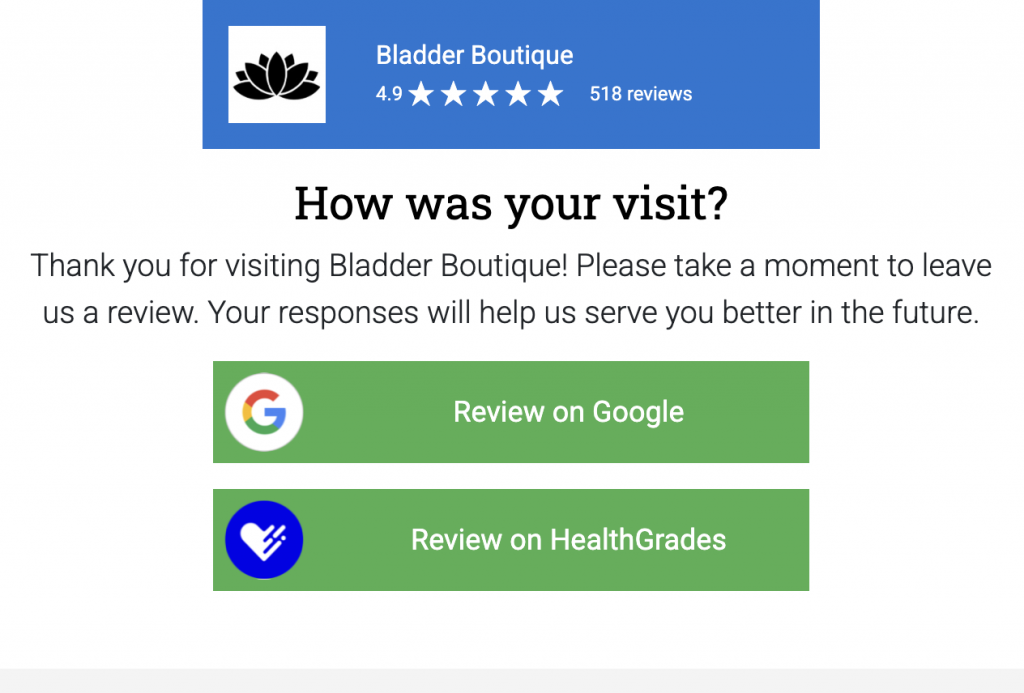
Connect your CRM/EHR/POS or trigger via Zapier. After a visit or purchase, Repudoc sends a simple, branded email/SMS to all customers (not just happy ones). That’s how we stay 100% within Google’s no-gating policy. - Frictionless pick-your-platform flow.
Customers choose where to leave a review (Google, Facebook, Yelp, Healthgrades, WebMD, etc.). For Google, we deep-link to your Business Profile’s review form to reduce clicks. - No incentives. No tricks.
We never offer rewards or filter out unhappy customers. Every recipient sees the same options: public review links and an additional private feedback link. That keeps you compliant while still giving dissatisfied customers a dignified path to share detail privately. - Smart timing, reminders, and personalization.
Send at the right moment (e.g., 2–24 hours after service), with one polite reminder if unopened. Messages reference the exact service or provider, which meaningfully increases conversion. - Review monitoring + response assist.
See new reviews in one dashboard, route alerts to the right team, and use Repudoc’s AI-assisted drafts to respond professionally (and fast). Responses themselves are a quality signal. - Distribution you control.
Automatically publish select first-party testimonials on your site with proper schema.org AggregateRating/Review markup so search/AI can understand and attribute them. (Third-party reviews remain on the platforms where they belong.) - Analytics that match what search/AI reward.
Track rating, volume, velocity, recency, response rate, and platform coverage—the exact inputs that influence both local SEO and AI inclusion.
How stronger reviews lift Google/Bing and AI visibility
- Local pack & organic uplift: More high-quality, recent reviews correlate with better local rankings and higher click-through on both Google and Bing. That leads to more traffic—one of the best feedback loops you can create.
- AI answer inclusion: When AI assistants assemble “best of” lists, they lean on signals they can verify: star ratings, counts, and consistency across profiles. A business with 4.9★ across hundreds of fresh reviews and matching NAP data is a safer pick for the model to recommend and cite.
- Credible citations: Many AI experiences now show sources. If your brand’s Google profile, directory pages, and on-site testimonials are healthy and aligned, you give AI systems multiple credible places to point.
Your AI-Readiness Checklist (Repudoc + site hygiene)
- Max out your Google Business Profile.
Primary/secondary categories, services, photos, hours, service area, appointment links, messaging, and Q&A. Repudoc plugs into the “leave a review” flow and monitors new feedback. - Consistency everywhere.
Ensure NAP matches across Google, Bing, Facebook, Yelp, Apple Business Connect, and key vertical directories. Repudoc flags problem listings so you can fix them once. - On-site review markup.
Publish a lightweight “Reviews” or “Patient Stories” section with schema.org markup (AggregateRating + Review) and ensure the numbers match your public profiles. Repudoc can auto-embed first-party testimonials and keep the counts current. - Answer your reviews.
A fast, courteous response cadence is visible to humans and machines. Repudoc’s response suggestions keep tone consistent and HIPAA/privacy-aware for healthcare. - Sustain velocity (the quiet superpower).
Ten reviews this week and zero for months sends mixed signals. It’s better to get a steady trickle forever. Repudoc’s automation does exactly that.
What about compliance?
You’ll never see Repudoc:
- Gate reviews (only sending to happy customers). Everyone gets the same public links.
- Incentivize reviews with discounts or gifts.
- Fabricate reviews or ask staff to post under aliases.
We’d rather grow slower than put your domain, licenses, or ad accounts at risk. Long-term trust is the only strategy that works.
A simple rollout plan (takes an afternoon)
- Connect Repudoc to your CRM/EHR/POS or Zapier trigger.
- Load your approved message templates (email/SMS) and brand assets.
- Add your platform links (Google, Facebook, Yelp, Healthgrades, WebMD, etc.).
- Turn on the post-visit automation with a single reminder after 48–72 hours.
- Embed first-party testimonials on your site with review schema.
- Assign review response owners and enable alerts.
- Monitor rating, volume, recency, and platform coverage weekly.
Within a few weeks you’ll see two things: (1) rising local rankings and CTR as fresh 5-stars accumulate, and (2) more frequent inclusion when AI assistants list “top” options in your category. You’re essentially teaching the machines that your brand is the safe, high-quality choice.
The takeaway
Search and AI don’t “trust” a business because of slogans; they trust the patterns they can verify. Public customer reviews are the cleanest, most universal signal of real-world quality. Repudoc gives you a compliant, repeatable way to grow that signal—steadily, month after month—so you rank higher, convert better, and show up more often when AI answers the next prospect’s question.
If you want help setting this up, we can wire your messaging, review links, and schema in a single session—and you’ll be AI-ready the moment your next happy customer walks out the door.
Final Thoughts
Getting more 5-star Google reviews doesn’t have to be complicated — it just needs to be authentic, consistent, and compliant.
If you’re ready to automate the process and protect your reputation the right way,
👉 Start a free trial here and see how easy it is to grow your reviews on autopilot.